
Claude Watermarks Explained: What Anthropic Marks, What Survives, and What It Means for Code
A detailed fact-check of the viral “Claude watermarks your code” claim—covering statistical text marks, C2PA provenance, Claude Code, EU rules, limitations and practical examples.
A new video from Theo – t3.gg, published on August 14, 2026, opens with a provocative claim: “Claude watermarks your code now.” Over 32 minutes, it explains why watermarking text is much harder than marking media, why many marks can be weakened by ordinary editing, and why signed provenance may ultimately be more useful than trying to identify every piece of AI output.
What the video is talking about
The video begins with the familiar problem of AI detection: stylistic habits can make writing look machine-generated, but they are not reliable proof. It then connects Anthropic’s new marking policy to Article 50 of the EU AI Act and the EU Code of Practice on Transparency of AI-Generated Content.
Its argument unfolds in three layers. First, it demonstrates how much hidden room exists inside image data and how resizing, recompression, format conversion or small filters can change that data. Second, it explains the narrower design space for plain text, where changing a token may alter meaning or style. Third, it argues that any public detection system creates a cat-and-mouse game: people can repeatedly edit content until the signal is no longer detected.
The video’s six main claims
- 00:00–03:00 — AI authorship is difficult to infer from style alone, and the EU’s new transparency rules are pushing providers toward machine-readable marking.
- 03:00–14:50 — Media files provide many places to hide provenance or watermark signals, but transformations such as recompression and resizing can damage some signals.
- 14:50–18:00 — Anthropic plans two different mechanisms: an embedded mark in generated text and C2PA-compatible signed metadata on supported files.
- 18:00–26:15 — Statistical text marking can influence token selection, while Unicode substitutions are another possible technique. The video stresses that Anthropic has not publicly described its exact implementation.
- 26:15–28:00 — C2PA metadata can attest to processing history and tampering, but plain text usually has no file container in which to carry a signature.
- 28:00–31:58 — The speaker concludes that marks may identify low-effort copy-paste use, but determined actors will often be able to weaken them. He favors authenticating trustworthy human-origin media and improving public literacy.
What Anthropic officially says
Anthropic’s own source is the help article How Claude marks AI-generated content, updated August 10, 2026. Anthropic says it signed the EU Code of Practice as both a provider of generative models and generative systems.
For Claude models launched on or after August 2, 2026, machine-readable marking is supported from launch. Anthropic is also working to add marking support to models released before that date. The policy applies to supported models wherever Claude is offered, not only when a user is physically located in the EU.
How a text watermark can work
A language model does not normally choose its next token from a single inevitable answer. It scores many possible tokens and samples among plausible options. A statistical watermark can introduce a small coordinated preference during that selection process. Across a long output, a detector can look for the resulting pattern.
Figure 1 — A clearer conceptual view of statistical text marking: plausible next tokens receive a small coordinated preference, repeated choices form a pattern, and a detector evaluates that pattern across enough text. Anthropic has not published Claude’s exact algorithm.
Is Claude hiding unusual Unicode characters?
The video discusses homoglyphs and unusual spaces because they can encode invisible information cheaply. It cites developer observations and an analysis by Sean Goedecke, but this part is speculation—not an Anthropic disclosure. Anthropic’s documentation does not say that the new watermark is a Unicode-space trick, nor does it reveal whether its system resembles Google’s SynthID approach.
Does Claude watermark code?
Anthropic says embedded watermarks apply to all generated text from supported models across Claude Code. Code is token output, so it is reasonable to infer that code-generation output falls within the policy. However, the help article does not publish a separate “code watermark” specification or promise that every function, patch or repository will produce a detectable result.
This distinction matters because code is often short, repetitive and constrained by syntax. A ten-line utility may offer fewer harmless token choices than a 1,000-word essay. A repository also mixes model output with templates, dependencies, formatters, generated files and human edits. Even if a detector finds a Claude signal, that does not allocate authorship line by line.
// Example: this function may be too short and constrained
// for any detector to draw a reliable conclusion.
export function clamp(value, min, max) {
  return Math.min(max, Math.max(min, value));
}
Example 1 — A short, conventional function has limited variation. Anthropic explicitly lists very short passages as a case where a detectable mark may be unavailable.
# Example: mixed provenance in a real pull request
1. Developer writes the API contract.
2. Claude Code drafts an implementation and tests.
3. A formatter rewrites whitespace.
4. The developer changes error handling and names.
5. CI generates snapshots.

Result: the repository is neither purely human nor purely AI-authored.
Example 2 — A detected mark would indicate possible Claude processing somewhere in the surviving material. It would not prove that Claude designed the feature, that every line came from Claude, or that the code is unsafe.
Four developer scenarios
Text watermarks and C2PA are not the same thing
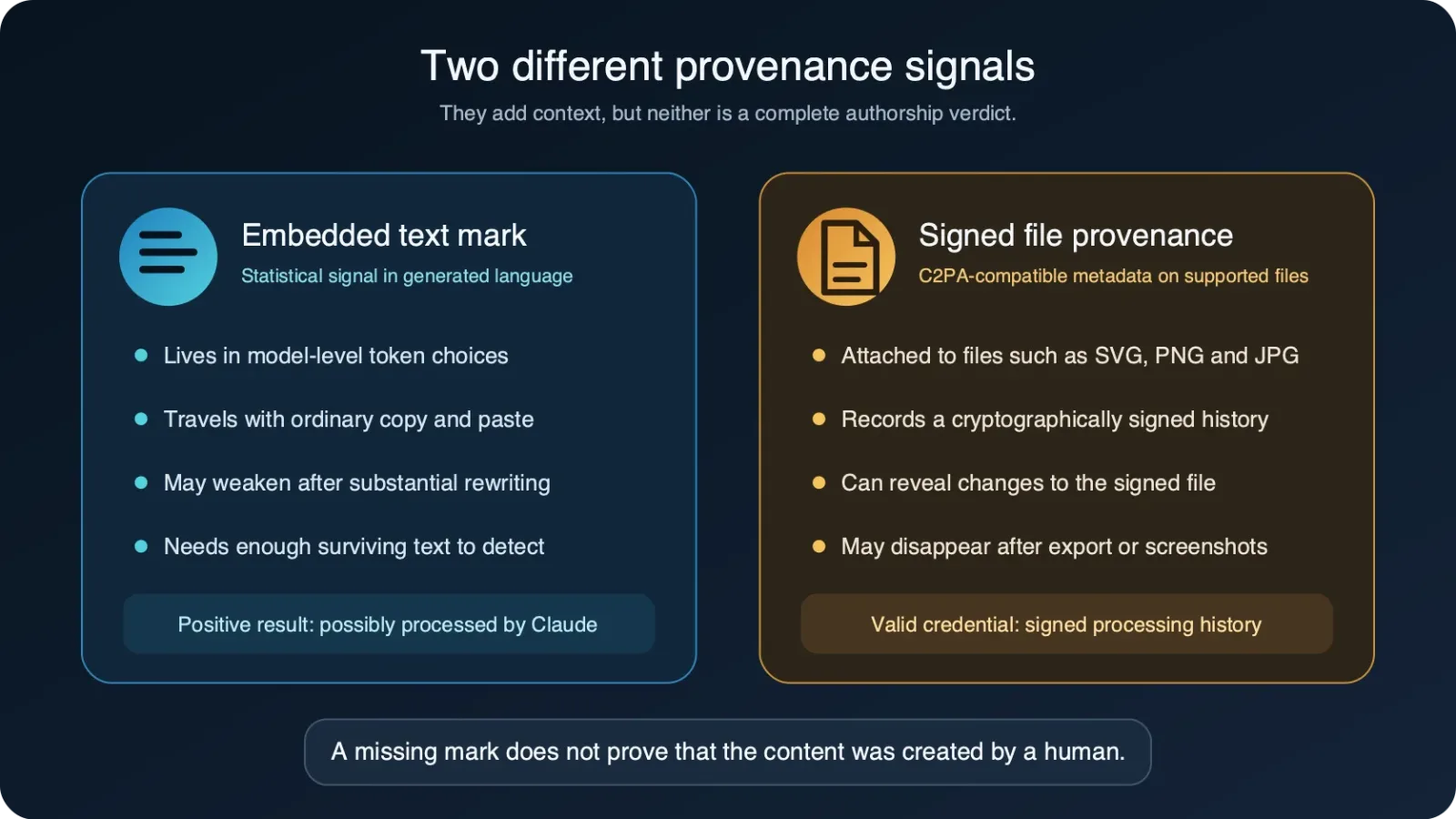
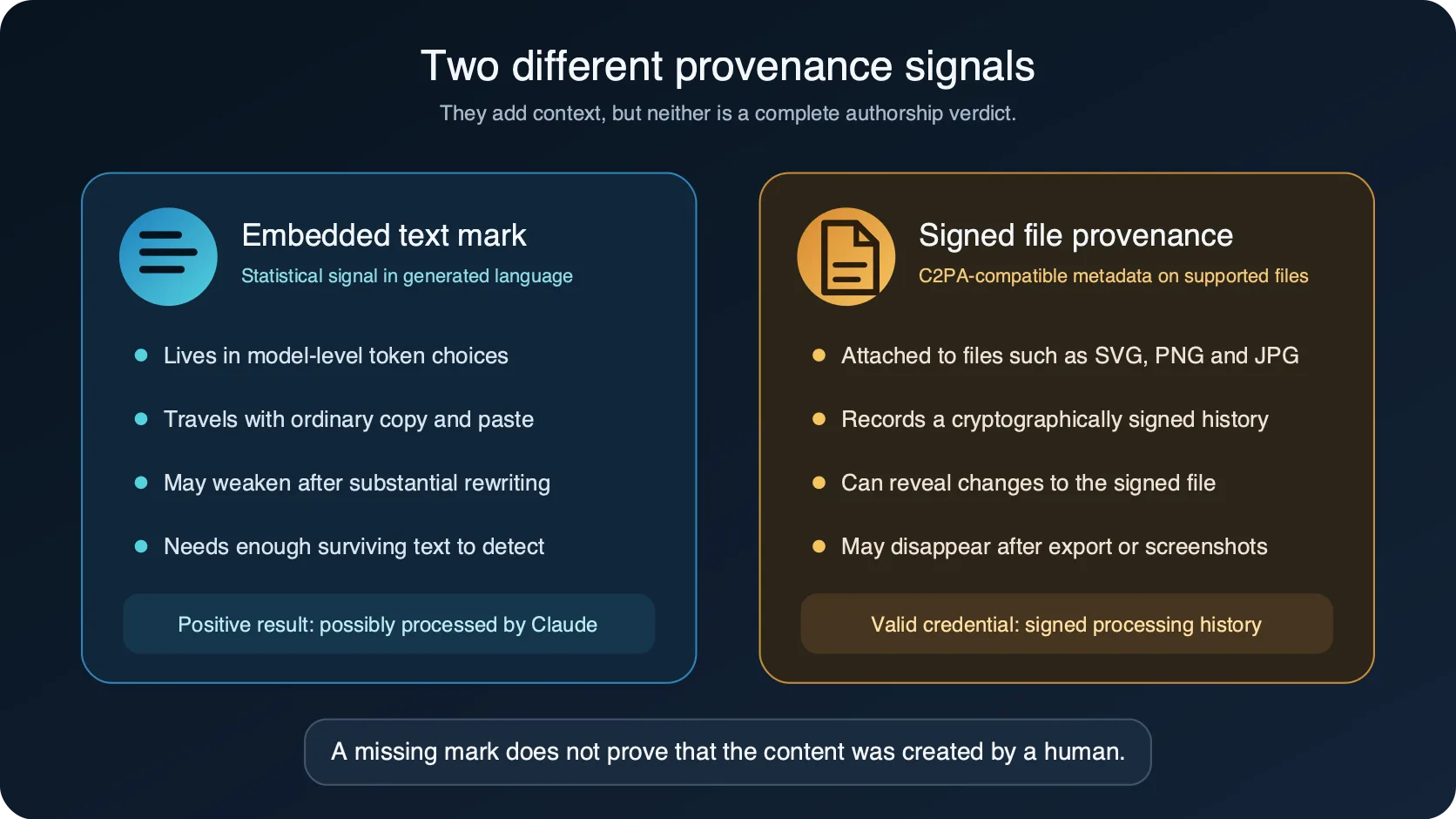
The video is strongest when it separates the two layers. An embedded text mark is part of token selection. C2PA provenance is signed metadata attached to a file container. They solve related but different problems.
Anthropic currently names SVG, PNG and JPG as examples of supported files. This does not mean pixels themselves necessarily contain the same kind of durable watermark as text. The documented mechanism is signed provenance metadata.
The limitations Anthropic explicitly acknowledges
- A detected mark is a signal, not conclusive proof of full provenance.
- Claude may have proofread, translated, summarized or converted material that originated with a human or another source.
- Marked material may later be edited, excerpted or mixed with other content.
- Older models may not yet support marking.
- Heavy editing, paraphrasing, translation or mixing can prevent text detection.
- A short passage may not contain enough signal.
- File conversion, re-saving or screenshots can strip provenance metadata.
- Some platforms, features and file types may not support every marking layer.
The most important rule for interpreting a detector is asymmetric: finding a mark can be useful evidence of processing; failing to find one is not evidence of human origin.
Fact-checking the video’s biggest claims
Why the EU rules exist
The European Commission’s Code of Practice page says the aim is to reduce deception and manipulation by making generated or altered text, image, video and audio machine-detectable where technically feasible. The code is voluntary as a compliance route, but Article 50 transparency obligations are legal requirements.
The rules also distinguish provider obligations from publisher or deployer obligations. Providers build machine-readable marking into generative systems. Deployers may need visible disclosure for deepfakes and for certain AI-generated text on matters of public interest when there has been no human review or editorial responsibility.
The Commission’s Quick Facts also notes an exception for assistive standard editing that does not substantially alter the input or its meaning. That legal nuance is broader than a simple rule saying every spell-check or formatting change must be labelled.
Figure 2 — Key 2026 dates for the EU transparency framework and Anthropic’s rollout. The December date is the stated transition point for systems placed on the market before August 2.
What developers and teams should do
Do not turn watermark detection into an authorship tribunal
A detector is not a plagiarism test, a security scanner or a measure of engineering quality. False conclusions are especially likely for mixed codebases, short snippets and human work that Claude merely reformatted or reviewed.
Use direct provenance that already exists
- Keep meaningful commits and pull-request discussions showing who proposed, reviewed and accepted a change.
- Link agent sessions or task records when your tooling supports traceable run links.
- Require tests, security review and human approval for consequential code regardless of who drafted it.
- Document where AI assistance is permitted and what disclosure is expected instead of relying on a detector alone.
Treat C2PA as positive provenance, not a universal truth test
A valid signed credential can be valuable because it gives verifiable information about a specific file’s history. But the open internet contains enormous amounts of legitimate media without credentials. A screenshot or exported derivative may also lose its original metadata.
Assess Article 50 for your own product
Anthropic explicitly tells API customers and product builders to make their own assessment of Article 50. Using Claude’s built-in marks may help, but it does not automatically satisfy every disclosure, interface or editorial obligation that applies to a deployed service.
Practical examples
Example A: a press release edited by Claude
A communications team writes a release, then asks Claude to tighten the language. The final copy may carry a Claude signal even though the facts, argument and most sentences originated with the team. Detection establishes possible processing, not original authorship.
Example B: a Claude Code pull request
Claude Code drafts a large migration, a developer rewrites the critical transaction logic, and the formatter changes the entire diff. Some surviving prose or code may still be detectable; some may not. Review quality, tests and accountability matter more than a binary AI label.
Example C: an SVG converted to PNG
Claude processes an SVG and attaches signed provenance metadata. A design tool exports a PNG without preserving that metadata. The new file may no longer expose the credential, but that does not rewrite the historical fact that Claude processed the source.
Example D: a short answer
A user asks Claude for a one-line regular expression. The result may be indistinguishable from the only conventional human solution. Anthropic lists short passages among the cases where detection may be unreliable.
Frequently asked questions
Can people see Claude’s watermark?
No. Anthropic describes the text mark as imperceptible. It is intended for machine detection, not visible labelling.
Does copy-paste remove it?
Anthropic says the signal travels with copied text and may survive some editing. It does not claim that it survives every rewrite, translation or mixture.
Will watermarking reduce model quality?
Anthropic says the mark does not change meaning, quality or readability. Because the technical design and evaluations are not yet public, independent assessment will have to wait for the promised documentation.
Is the text watermark the same as C2PA?
No. The text mark is embedded in generated language. C2PA is signed provenance metadata attached to supported file formats.
Does a missing mark prove that content is human?
No. This is one of Anthropic’s clearest warnings. Older models, unsupported surfaces, short text, editing and file conversion can all produce an undetectable result.
Can the public detect Claude marks today?
Anthropic says it is working on detection access and will publish technical details. As of August 14, 2026, the help article does not provide a public detector or full algorithm specification.
Does the policy apply outside Europe?
Yes, for supported models. Anthropic says marking applies wherever Claude is offered worldwide, including supported access through major cloud partners.
Bottom line
The video is right about the central engineering tension: a useful watermark must be subtle, detectable and robust, while ordinary editing should remain possible. Those goals pull against one another—especially for text and code.
But “Claude watermarks your code” should not be interpreted as a perfect, permanent signature on every repository. Anthropic is deploying two provenance signals with carefully stated limits. Their best use is to add context, not to deliver a verdict.
Sources and methodology
This article was researched and written on August 14, 2026. The video was transcribed locally because YouTube captions were unavailable; sponsor material was excluded from the analysis. Claims were checked against Anthropic’s marking documentation, the European Commission’s Code of Practice overview, its Article 50 guidance announcement, and the Commission’s Quick Facts. Technical commentary on statistical and Unicode approaches was compared with Sean Goedecke’s analysis.
Visual and HTML examples you can reuse
The following images turn the two most important ideas into static, shareable visuals. Unlike the animated SVG blocks earlier in the article, these are uploaded PNG files and should display in readers, previews and social embeds that do not execute SVG animation.
HTML example: a visible AI-assistance disclosure
A machine-readable watermark is not a substitute for clear communication with readers. Publishers can pair provenance technology with a visible, accessible disclosure such as this:
<figure data-ai-disclosure="ai-assisted">
  <img
    src="/images/claude-watermark-explainer.png"
    alt="Diagram comparing a text watermark with signed file provenance"
  >
  <figcaption>
    AI-assisted illustration. The reporting, sources and final article
    were reviewed by a human editor.
  </figcaption>
</figure>HTML example: an expandable provenance note
For a long article, an expandable note can explain the workflow without interrupting the main narrative:
<details class="provenance-note">
  <summary>How AI was used in this article</summary>
  <p>
    AI tools assisted with transcription, structure and illustration.
    A human editor checked claims against Anthropic and European
    Commission sources, revised the copy and approved publication.
  </p>
</details>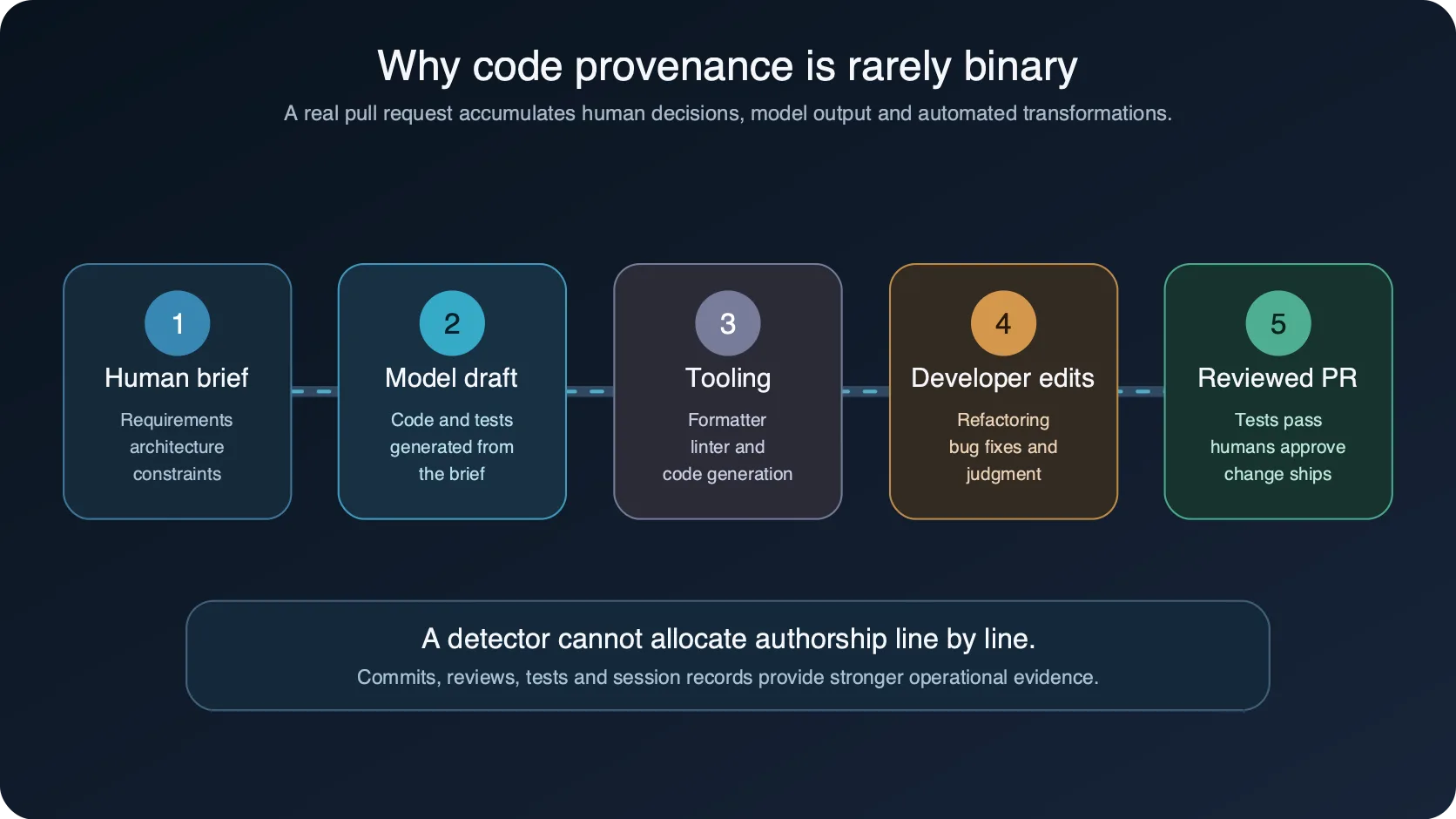
HTML example: documenting AI assistance in a code change
A team can describe the actual development process directly in a pull-request page, internal changelog or engineering report. That record is often more informative than a detector result:
<aside class="provenance-note" aria-labelledby="provenance-title">
  <h3 id="provenance-title">Development provenance</h3>
  <ul>
    <li>Requirements and architecture: human-authored</li>
    <li>Initial implementation and tests: drafted with Claude Code</li>
    <li>Security-sensitive logic: rewritten and reviewed by developers</li>
    <li>Validation: formatter, linter, test suite and human approval</li>
  </ul>
</aside>
HTML example: a compact comparison table
<table>
  <caption>Claude provenance signals</caption>
  <thead>
    <tr>
      <th scope="col">Signal</th>
      <th scope="col">What it can indicate</th>
      <th scope="col">What it cannot prove</th>
    </tr>
  </thead>
  <tbody>
    <tr>
      <th scope="row">Embedded text mark</th>
      <td>The text may have been processed by a supported Claude model</td>
      <td>That Claude originated every idea or sentence</td>
    </tr>
    <tr>
      <th scope="row">Signed file provenance</th>
      <td>A supported file carries a signed processing history</td>
      <td>That an unsigned file was created by a human</td>
    </tr>
  </tbody>
</table>
These HTML patterns are intentionally simple and accessible. They add visible editorial transparency, but they do not generate or preserve Anthropic’s hidden text signal and do not replace genuine C2PA signing.