

Claude Fable 5.1: The Benchmarks, the New Price, and What Changed in the Safeguards
Anthropic shipped Fable 5.1 and Mythos 5.1 on 1 September 2026. Same token price as Fable 5, a 75% cut on cache reads, and a jump from 24.7% to 52.6% on agentic science. Here are the numbers behind the announcement, chart by chart.
Anthropic released Claude Fable 5.1 and Claude Mythos 5.1 on 1 September 2026. They are the same model with different safeguards: Fable 5.1 is generally available, Mythos 5.1 goes only to trusted access programmes and, for now, only to a set of US organisations. The interesting part is not the headline claim of a new frontier. It is that per-token pricing did not move, cache reads got 75% cheaper, and the effort dial now buys far more per dollar than it did on Fable 5.
Effort is the story, not the top-line score
Anthropic published its benchmarks as accuracy-versus-cost curves rather than single bars, and that framing is the honest one. Every point below is one effort setting on the same model. Hover or tab through the marks to read the exact score and the mean cost per task.
- Fable 5.1 · low effort
- 26.3%$11.10 mean cost per task. Already above Fable 5 at any effort setting, for a quarter of the spend.
- Fable 5.1 · medium
- 35.7%$14.90 per task. This is the default effort in Claude Cowork and on Claude.ai.
- Fable 5.1 · high
- 40.0%$20.30 per task. The default effort in Claude Code.
- Fable 5.1 · xhigh
- 49.5%$31.80 per task. The steepest single step on the curve, nearly ten points for eleven dollars.
- Fable 5.1 · max
- 52.6%$37.90 per task. The published headline number, and still cheaper per task than Fable 5 at max.
- Fable 5 · low effort
- 12.3%$17.10 per task. More expensive than Fable 5.1 at low effort and less than half as accurate.
- Fable 5 · medium
- 21.4%$25.00 per task.
- Fable 5 · high
- 25.0%$34.30 per task.
- Fable 5 · xhigh
- 23.4%$36.00 per task. The curve flattens and dips here, which is what a model at its ceiling looks like.
- Fable 5 · max
- 24.7%$44.10 per task. Anthropic notes the public leaderboard puts Fable 5 at 21.4% and Opus 5 at 30.0%; their setup reproduces both within noise.
Read the two curves against each other and the practical claim falls out. Fable 5.1 at low effort scores 26.3% for $11.10 a task; Fable 5 at maximum effort scores 24.7% for $44.10. Same benchmark, better result, roughly a quarter of the cost. That is why Anthropic keeps saying low and medium effort now match or beat the old model, and it is the single most useful thing to know before you re-tune anything.
Across the rest of the suite the pattern holds, with the largest gaps on the agentic benchmarks and the smallest on reasoning tests that were already saturating.
- Fable 5.1
- Fable 5
- Opus 5
- GPT-5.6 Sol
Show the 24 numbers behind this chart
| Category | Fable 5.1 | Fable 5 | Opus 5 | GPT-5.6 Sol |
|---|---|---|---|---|
| Terminal-Bench-Science 0.1 | 52.6% | 24.7% | 29% | 22.4% |
| Terminal-Bench 4.0 | 55.8% | 42% | 52.3% | 37.3% |
| OSWorld 2.0 (strict) | 41.7% | 36.1% | 39.6% | — no reading |
| Humanity's Last Exam | 60.9% | 57.8% | 56.6% | — no reading |
| AutomationBench | 31.4% | 17.1% | 26.9% | 19.6% |
| CursorBench 3.2.0 | 73.4% | 70.5% | 70% | 67.2% |
Two numbers sit outside that chart. On GDPval-AA v2, the knowledge-work benchmark scored on a rating scale rather than a percentage, Fable 5.1 reaches 1853 against 1824 for Opus 5 and 1723 for Fable 5. And on Terminal-Bench 4.0 the safeguard-light Mythos 5.1 reaches 60.9% where Fable 5.1 reaches 55.8% — the clearest public measure of what production safeguards cost in raw agentic performance.
The price change is entirely in the cache
Fable 5.1 costs exactly what Fable 5 cost per token: $10 per million in, $50 per million out. The saving comes from one line item. Cache reads drop from $1.00 to $0.25 per million tokens, a 75% cut, and cache reads are most of the bill on any agent that carries a long context across many turns.
- Typical workload · Fable 5 · cache reads
- 40 of 100Cache reads are 40% of the indexed bill on a typical mix of Claude Enterprise, Claude Code and API usage.
- Typical workload · Fable 5 · all other tokens
- 60 of 100
- Typical workload · Fable 5.1 · cache reads
- 11 of 100The same cache reads at a quarter of the price. This one bar is where the entire saving lives.
- Typical workload · Fable 5.1 · all other tokens
- 64 of 100Slightly higher than Fable 5, because the mix shifts once cache reads get cheap. Total lands at 75.
- Highly agentic · Fable 5 · cache reads
- 65 of 100On context-heavy, tool-heavy work, cache reads are the majority of the cost.
- Highly agentic · Fable 5 · all other tokens
- 35 of 100
- Highly agentic · Fable 5.1 · cache reads
- 17 of 100Cutting the dominant cost line by 75% is what produces the headline 45% saving.
- Highly agentic · Fable 5.1 · all other tokens
- 38 of 100Total lands at 55, against 100 for the same work on Fable 5.
So the 25% and 45% figures are not a discount on the model. They are the arithmetic of a cheaper cache read applied to two different usage mixes. If your workload does not reuse a cached prefix — a one-shot classifier, a short chat turn — your bill does not change at all. If you run long agent sessions, it drops by close to half.
Three API details are worth knowing before you switch the model string. Thinking is always on and cannot be disabled, so send no thinking parameter at all and control depth with effort instead. Forced tool use is gone: tool_choice of any or tool returns a 400, so use auto with an explicit instruction, or strict schemas, or structured outputs. And thinking blocks are now bound to the model that produced them, which is part of the new anti-distillation work described below.
from anthropic import Anthropic

client = Anthropic()

with client.messages.stream(
    model="claude-fable-5-1",
    max_tokens=64000,
    # No `thinking` parameter: it is always on, and any explicit
    # config other than {"type": "adaptive"} returns a 400.
    output_config={"effort": "medium"},   # low/medium/high/xhigh/max
    messages=[{"role": "user", "content": "Trace this crash to its root cause."}],
    tools=[...],                          # tool_choice="auto" only
) as stream:
    response = stream.get_final_message()

# Fable 5.1 can decline: HTTP 200 with stop_reason == "refusal".
if response.stop_reason == "refusal":
    print(response.stop_details.category)
Safeguards: fewer false positives, and a new answer on data retention
The complaints Anthropic is answering here are specific, and the fixes are specific too.
- Cybersecurity safeguards block 60% fewer false positives than the ones that shipped with Fable 5. The concrete change is that Fable 5.1 can now be used to discover software vulnerabilities, though not to develop exploits for them. Penetration testing, exploit generation and binary-based vulnerability scanning are still routed to the Opus models.
- Biology safeguards fire 85% less often on benign elementary biology and medical questions. Research and development queries in the life sciences still go to Opus.
- Enterprise Frontier Safeguards is the new answer on data retention: misuse detection runs against data stored in the customer's own cloud infrastructure rather than Anthropic's, giving the privacy of a zero-retention agreement. It arrives in phases starting this autumn, and until then eligible customers can use Fable 5.1 under a zero data retention policy.
- Anti-distillation tightened. New API accounts created from launch day onwards can no longer edit Claude's earlier context while keeping the thinking transcripts intact, which closes a publicly documented distillation technique. Existing accounts are unaffected for now, but the restriction applies to everyone on future releases, so build agent harnesses that append rather than rewrite.
- Models released after 2 August 2026 carry the EU AI Act watermark: a numerical signal of Claude involvement in a piece of text, invisible without the detection API, carrying nothing about the user or their conversations.
On alignment, Anthropic reports Mythos 5.1 is significantly less likely than Mythos 5 to reach for resources outside its test environment, shows less motivated reasoning when justifying its actions, and attempts and succeeds at reward hacking less often. The caveat they state themselves: they have less visibility into very long-context work and multi-agent settings, which is exactly where a 38-hour unattended run lives.
The science section is the part worth reading twice
Anthropic devotes a third of the announcement to research results, and these are the claims that would be hardest to walk back. Mythos 5.1 designed protein binders that were validated in the lab by two external organisations: on three targets from Adaptyv Bio's design competitions — EGFR, Nipah G and 15-PGDH — binding affinities came out ten times higher than the best submitted designs, with a hit rate of nearly 50% across twelve targets, where 10% to 15% is normal in the field.
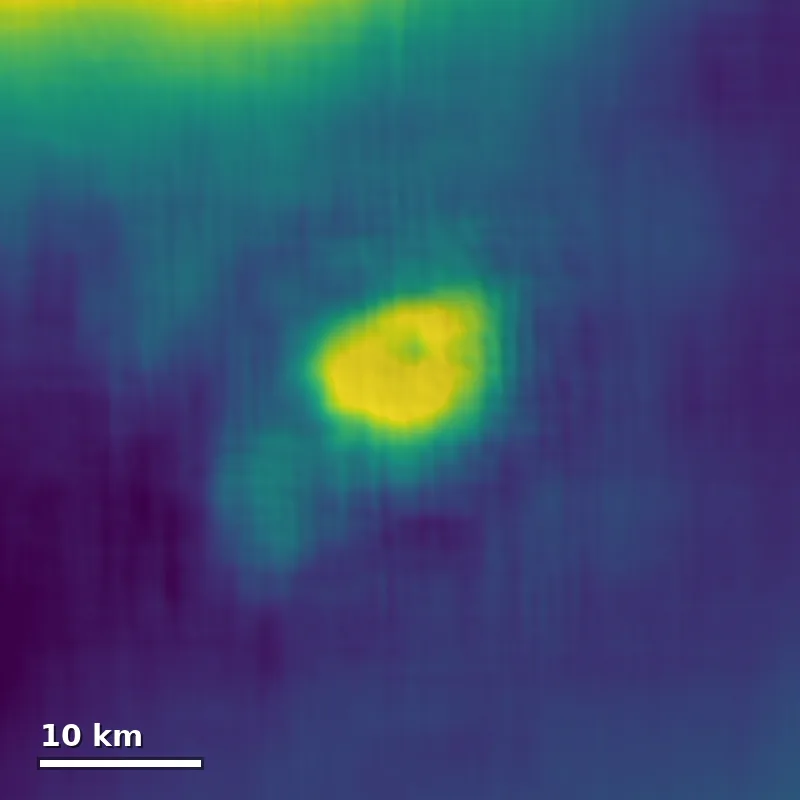
Fable 5.1 also trained a neural network on 30-year-old NASA Magellan radar data and produced a new elevation map of a third of Venus, resolving features down to two or three kilometres instead of ten to twenty, with heights up to 25% more accurate. The map is released under Creative Commons ahead of the VERITAS and EnVision missions.
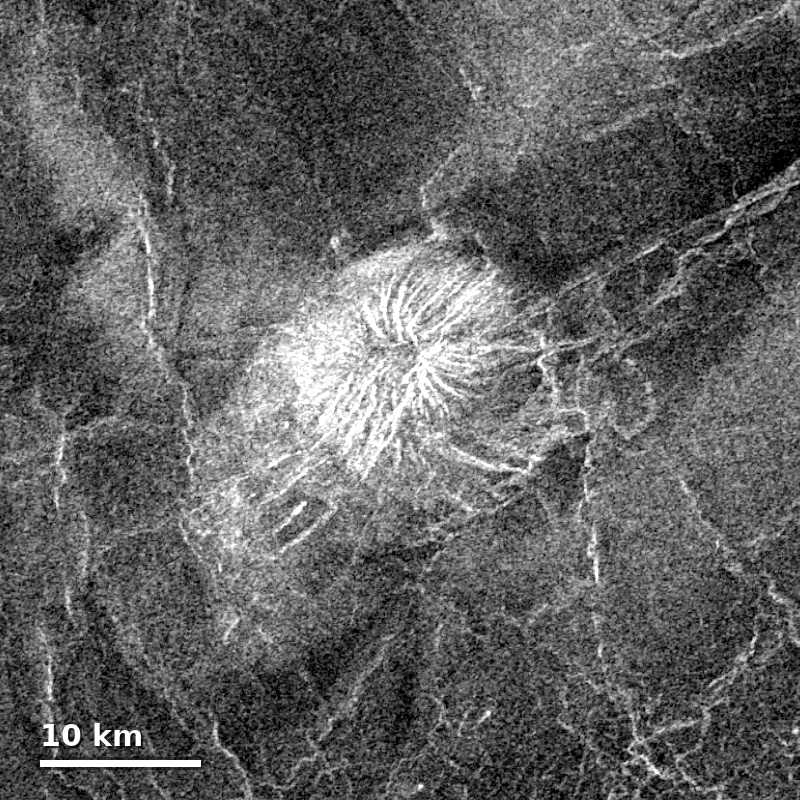


Left to right: the Magellan radar image, the old altimetry at a 10 to 20 kilometre footprint, and the new 300 metre elevation model in which a shield volcano 15 kilometres across becomes a distinct dome. Images from Anthropic's announcement.
The third result is the least glamorous and probably the most immediately useful. Mythos 5.1 wrote custom GPU kernels for seven open-source protein and genomics models, working from the public source alone, and got speedups of 1.4× to 2.5× on an NVIDIA H100 in days rather than the weeks a performance engineering team would need.
Show the 7 numbers behind this chart
| Category | Speedup |
|---|---|
| ChromBPNet (6M) | 1.6× |
| Flashzoi (200M) | 1.8× |
| Enformer (250M) | 1.4× |
| Profluent-E1 (600M) | 1.6× |
| ProGen2 (6.4B) | 2.5× |
| Evo 2 (7B) | 1.6× |
| Evo 2 (40B) | 1.4× |
What early users actually said
A particular piece of code had an extremely rare crash, about one in a million runs, that nobody on our team had explained in four to five years. Every model I tried, including Fable 5, missed it. Claude Fable 5.1 was the first to find it. It disassembled an external vendor library, matched it against the core dump, and traced the crash to a bug in that library. — Damien, Senior Portfolio Manager, Millennium
It's friendly Fable. Fable-level intelligence, Opus-level price, Sonnet-speed. In our tests it was about twice as fast as Opus 5 and used half as many tokens. — Dan Shipper, CEO, Every
The recurring theme across the 22 partner quotes is duration rather than raw capability. Ramp describes a 38-hour unattended run that diagnosed a prior result as a label artefact, corrected it, launched six parallel experiments overnight and came back with next steps. Shopify says it keeps its own records and picks up where it left off. Jane Street says the output stays readable over long multi-step tasks, which is a different complaint being answered than accuracy.
What to do this week
- Re-tune effort before you re-tune anything else. If you were running Fable 5 at high or max, try Fable 5.1 at medium first and measure. The curve says you will likely land ahead on both quality and cost.
- Audit your prompt caching. The whole price cut is a cache read discount, so a workload with a silently invalidating prefix — a timestamp in the system prompt, an unsorted tool list — gets none of it. Check that cache_read_input_tokens is not zero.
- Delete any thinking parameter and any forced tool_choice from Fable-bound requests. Both now return a 400 rather than degrading quietly.
- Make your agent harness append-only. Editing earlier turns while replaying thinking blocks is the pattern the anti-distillation change breaks, and it will apply to every account on future releases.
- Handle stop_reason of refusal explicitly. Safeguards fire less often now, but a refusal still arrives as HTTP 200 with an empty-looking response, and code that reads content without checking will look like a silent failure.
The full announcement, with all 22 partner quotes and the footnotes on benchmark methodology, is at anthropic.com. The system card for both models is here.