

Where European Businesses Use AI Most: The 2026 Map
Eurostat’s 2026 edition reveals a wide AI-adoption gap across Europe. Explore the geographic map and the companies leading the region.
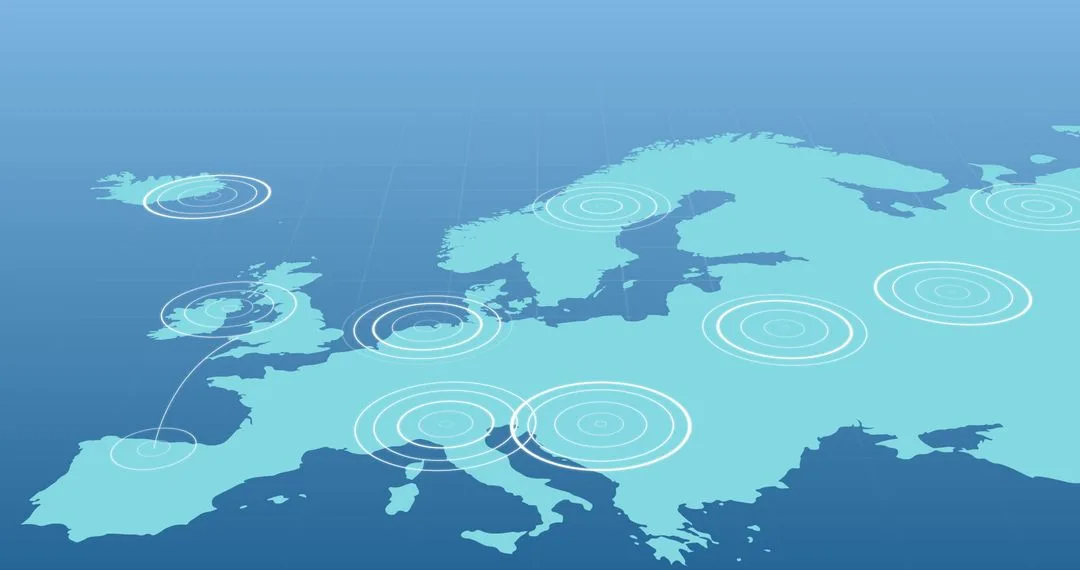
Artificial intelligence is no longer a niche experiment in European business. Eurostat’s 2026 edition—the newest available as of August 2026—shows that 19.95% of EU enterprises with at least 10 workers used one or more AI technologies. The observations refer to 2025 because Eurostat has not yet released reference-year 2026 country results.
Business AI adoption across Europe
The geographic map below accompanies Eurostat’s 2026 edition and uses its latest available country observations: reference year 2025 in dataset isoc_eb_ai. Hover over or focus a country to see its name, adoption rate and data status.
- Cyprus
- 9.27%Share of enterprises with 10+ workers using AI. Eurostat 2026 edition; reference year 2025.
- France
- 18.16%Share of enterprises with 10+ workers using AI. Eurostat 2026 edition; reference year 2025.
- Ukraine
- No comparable dataGrey indicates unavailable data, not zero.
- Belarus
- No comparable dataGrey indicates unavailable data, not zero.
- Lithuania
- 21.30%Share of enterprises with 10+ workers using AI. Eurostat 2026 edition; reference year 2025.
- Czechia
- 17.60%Share of enterprises with 10+ workers using AI. Eurostat 2026 edition; reference year 2025.
- Germany
- 25.97%Share of enterprises with 10+ workers using AI. Eurostat 2026 edition; reference year 2025.
- Estonia
- 23.40%Share of enterprises with 10+ workers using AI. Eurostat 2026 edition; reference year 2025.
- Latvia
- 12.21%Share of enterprises with 10+ workers using AI. Eurostat 2026 edition; reference year 2025.
- Norway
- 28.89%Share of enterprises with 10+ workers using AI. Eurostat 2026 edition; reference year 2025.
- Sweden
- 35.04%Share of enterprises with 10+ workers using AI. Eurostat 2026 edition; reference year 2025.
- Finland
- 37.82%Share of enterprises with 10+ workers using AI. Eurostat 2026 edition; reference year 2025.
- Luxembourg
- 33.61%Share of enterprises with 10+ workers using AI. Eurostat 2026 edition; reference year 2025.
- Belgium
- 34.54%Share of enterprises with 10+ workers using AI. Eurostat 2026 edition; reference year 2025.
- North Macedonia
- No comparable dataGrey indicates unavailable data, not zero.
- Albania
- 8.99%Share of enterprises with 10+ workers using AI. Eurostat 2026 edition; reference year 2025.
- Kosovo
- No comparable dataGrey indicates unavailable data, not zero.
- Türkiye
- 7.41%Share of enterprises with 10+ workers using AI. Eurostat 2026 edition; reference year 2025.
- Spain
- 20.27%Share of enterprises with 10+ workers using AI. Eurostat 2026 edition; reference year 2025.
- Denmark
- 42.03%Share of enterprises with 10+ workers using AI. Eurostat 2026 edition; reference year 2025.
- Romania
- 5.21%Share of enterprises with 10+ workers using AI. Eurostat 2026 edition; reference year 2025.
- Hungary
- 10.37%Share of enterprises with 10+ workers using AI. Eurostat 2026 edition; reference year 2025.
- Slovakia
- 18.00%Share of enterprises with 10+ workers using AI. Eurostat 2026 edition; reference year 2025.
- Poland
- 8.36%Share of enterprises with 10+ workers using AI. Eurostat 2026 edition; reference year 2025.
- Ireland
- 19.64%Share of enterprises with 10+ workers using AI. Eurostat 2026 edition; reference year 2025.
- United Kingdom
- No comparable dataGrey indicates unavailable data, not zero.
- Greece
- 8.93%Share of enterprises with 10+ workers using AI. Eurostat 2026 edition; reference year 2025.
- Austria
- 29.95%Share of enterprises with 10+ workers using AI. Eurostat 2026 edition; reference year 2025.
- Italy
- 16.40%Share of enterprises with 10+ workers using AI. Eurostat 2026 edition; reference year 2025.
- Switzerland
- No comparable dataGrey indicates unavailable data, not zero.
- Netherlands
- 33.21%Share of enterprises with 10+ workers using AI. Eurostat 2026 edition; reference year 2025.
- Serbia
- 10.12%Share of enterprises with 10+ workers using AI. Eurostat 2026 edition; reference year 2025.
- Croatia
- 15.19%Share of enterprises with 10+ workers using AI. Eurostat 2026 edition; reference year 2025.
- Slovenia
- 21.61%Share of enterprises with 10+ workers using AI. Eurostat 2026 edition; reference year 2025.
- Bulgaria
- 8.55%Share of enterprises with 10+ workers using AI. Eurostat 2026 edition; reference year 2025.
- Montenegro
- 10.05%Share of enterprises with 10+ workers using AI. Eurostat 2026 edition; reference year 2025.
- Bosnia and Herzegovina
- 10.78%Share of enterprises with 10+ workers using AI. Eurostat 2026 edition; reference year 2025.
- Portugal
- 11.54%Share of enterprises with 10+ workers using AI. Eurostat 2026 edition; reference year 2025.
- Moldova
- No comparable dataGrey indicates unavailable data, not zero.
- Iceland
- No comparable dataGrey indicates unavailable data, not zero.
Coverage is broader than the EU wherever Eurostat publishes a comparable value. Kosovo is included on the map, along with the rest of geographic Europe. Countries without a comparable figure—including Kosovo—are grey and explicitly marked “No comparable data”; grey never means zero.
Europe’s highest adoption rates
Show the 6 numbers behind this chart
| Country | AI adoption |
|---|---|
| Denmark | 42.03% |
| Finland | 37.82% |
| Sweden | 35.04% |
| Belgium | 34.54% |
| Luxembourg | 33.61% |
| Netherlands | 33.21% |
The lowest comparable rates
Show the 6 numbers behind this chart
| Country | AI adoption |
|---|---|
| Romania | 5.21% |
| Türkiye | 7.41% |
| Poland | 8.36% |
| Bulgaria | 8.55% |
| Greece | 8.93% |
| Albania | 8.99% |
What the map really tells us
The gap is large: adoption in Denmark is roughly eight times Romania’s rate. Northern and parts of Western Europe form the strongest cluster, while several southern and eastern markets remain below 12%.
Momentum matters as much as the ranking. The EU average rose by 6.47 percentage points in one year. Almost every EU country increased, with Denmark, Finland and Lithuania recording the largest gains, according to Eurostat’s 2025 release.
Company size is another dividing line. In 2025, 55.03% of large EU enterprises used AI, compared with 30.36% of medium-sized enterprises and 17% of small enterprises. Access to data, specialist staff, computing capacity and integration budgets still shapes who can move from a pilot to production.
Show the 3 numbers behind this chart
| Enterprise size | AI adoption |
|---|---|
| Small | 17% |
| Medium | 30.36% |
| Large | 55.03% |
The most common use was analysing written language, reported by 11.75% of EU enterprises. Generating images, video or audio followed at 9.55%, while generating text, speech or code reached 8.76%.
Why northern and western Europe lead
Eurostat measures adoption, not its causes, so the map should not be treated as a causal study. A reasonable interpretation is that digitally mature firms, stronger cloud use, deeper technical talent pools and better access to capital make adoption easier. The large-enterprise advantage in the same survey supports that reading, but it does not prove that any one policy caused the ranking.
Low adoption does not mean low potential
A low national percentage can hide fast-growing startups, advanced manufacturers and multinationals already using AI extensively. It can also reflect the structure of the business population. The practical opportunity in lower-adoption markets may be especially strong for affordable, local-language tools that work without a large internal data-science team.
Leading AI companies in Europe
There is no single objective “best” AI company: a frontier-model laboratory, a video platform and an autonomous-driving company solve different problems. The companies below stand out for research strength, product maturity or leadership in an important European AI category.
Mistral AI — France
Mistral AI is Europe’s clearest independent contender in foundation models and enterprise generative AI. Its stack covers models, agents, application development, customization and infrastructure, with cloud, self-hosted and on-premises deployment options. It is a strong fit for organizations that care about control, European hosting and model portability.
Google DeepMind — United Kingdom
Google DeepMind remains Europe’s most influential frontier research laboratory, with work spanning general-purpose AI, biology, weather, mathematics and scientific discovery. It is headquartered in London but is part of Google, so it belongs on a list of European AI leaders—not a list limited to independent European-owned startups.
Aleph Alpha — Germany
Aleph Alpha focuses on specialized language models for regulated, business-critical settings. Its emphasis on European infrastructure, data sovereignty and domain-specific systems makes it especially relevant to government, industry and other organizations where compliance and control matter as much as benchmark performance.
Synthesia — United Kingdom
Synthesia is one of Europe’s strongest applied-AI businesses. Its platform turns scripts into presenter-led videos for training, onboarding, sales enablement and internal communication. It is a practical example of AI creating measurable business value without requiring customers to build a model themselves.
ElevenLabs — United Kingdom / Poland
ElevenLabs is a leader in AI speech, audio and conversational agents. Its platforms serve developers, creative teams and businesses deploying multilingual voice or chat experiences. The company’s Polish roots and London base make it one of the most visible success stories in Europe’s generative-AI ecosystem.
Wayve — United Kingdom
Wayve is building embodied AI for assisted and autonomous driving. Its approach learns from driving data and aims to generalize across vehicles and locations without depending on high-definition maps. For Europe’s automotive sector, it is one of the most important AI companies to watch.
Helsing — Germany
Helsing is a major European defence-AI company developing autonomous systems and software that connects existing hardware into AI-enabled networks. Its inclusion reflects technical and strategic importance, not a recommendation for a typical commercial buyer.
European AI companies with strong developer APIs
For businesses that want to embed AI inside their own product rather than buy a finished application, these European providers offer some of the strongest developer platforms:




Which company is best for a business need?
- Foundation models, private deployment and European infrastructure — Mistral AI or Aleph Alpha.
- Scientific research and frontier AI — Google DeepMind.
- Training, onboarding and internal video — Synthesia.
- Voice agents, dubbing and multilingual audio — ElevenLabs.
- Autonomous-driving intelligence — Wayve.
- Defence and autonomous systems — Helsing.
How a European business should start with AI
- Choose one expensive, repetitive workflow with a measurable baseline: time, error rate, conversion, resolution speed or cost.
- Start with assistance rather than full autonomy. Let AI draft, classify, search or summarize while a person approves consequential actions.
- Check where data is processed, how long it is retained, which models receive it and whether the deployment meets sector and EU requirements.
- Run a short pilot, compare the result with the baseline and scale only when the benefit survives real usage—not just a polished demo.
Methodology and limitations
The figures come from the 2025 EU survey on ICT usage and e-commerce in enterprises. They cover enterprises with at least 10 employees or self-employed persons in selected non-financial business activities. Microbusinesses, agriculture, mining and the financial sector are outside the main scope, so the percentages are not a count of every business in each country.
“Uses AI” means an enterprise reported at least one covered technology, including text analysis, speech recognition, text or code generation, image or audio generation, image recognition, machine learning, workflow automation or autonomous machines. The statistic does not measure intensity, spending, productivity or whether an AI project was successful.
Sources and update note
Researched and updated on August 14, 2026. This article uses Eurostat’s 2026 AI report and Digitalisation in Europe 2026. Both use the newest available business observations, for reference year 2025. The next Eurostat article update is planned for December 2026. Exact country values and methodology come from dataset isoc_eb_ai. Company descriptions were checked against the official company pages linked above.